



If you've shopped for an AI voice agent, you've probably seen attractive headline pricing. Those numbers can be real, but they do not always represent what eventually appears on your invoice.
Understanding AI voice agent cost means looking beyond a single advertised rate and understanding the technology, infrastructure, integrations, call volume, and features working together behind every conversation.
The cheapest advertised AI voice agent is not always the cheapest solution for a business. Reliability, integrations, call quality, automation capability, and successful call resolution matter just as much as the headline price.
The Short Answer
AI voice-agent pricing varies substantially depending on the provider, call volume, voice technology, AI model, telephony provider, integrations, concurrency requirements, and the complexity of the workflow.
A simple agent answering routine questions may require a very different infrastructure from an AI receptionist that qualifies leads, accesses a CRM, checks calendars, creates appointments, sends confirmations, transfers calls, and updates business systems automatically.
This is why businesses should evaluate the complete operating cost rather than comparing providers based only on an advertised per-minute number.
Why the Advertised Price Can Be Misleading
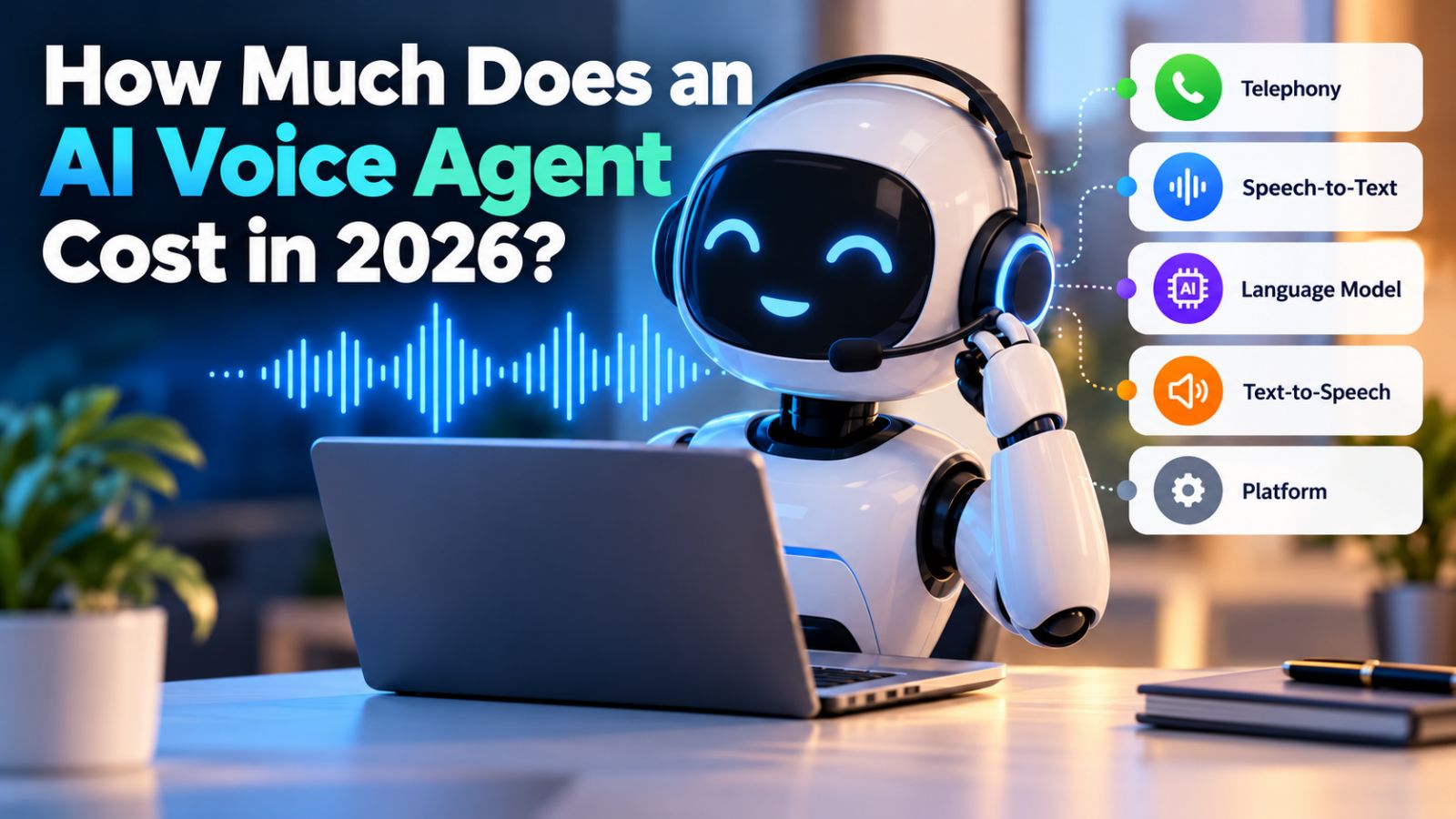
A production AI voice agent is rarely one service. Several technologies normally work together in real time to understand the caller, generate an appropriate response, speak naturally, connect to the telephone network, and perform business actions.
A typical AI voice stack can include:
- Telephony infrastructure
- Speech-to-text processing
- A large language model or AI reasoning engine
- Text-to-speech voice generation
- Voice-agent orchestration platform
- Call recording and storage
- CRM or business-system integrations
- Automation workflows
- Monitoring and analytics
Two providers may therefore advertise similar pricing while including completely different parts of the technology stack.
Advertised Rate ≠ Complete Business Cost
What Actually Drives AI Voice Agent Cost?
1. Telephony
Every AI phone agent needs a connection to the traditional telephone network. Providers such as Twilio and other cloud communication platforms handle incoming calls, outgoing calls, phone numbers, transfers, and telecommunications infrastructure.
Telephony usage depends heavily on the country, destination, number type, inbound versus outbound calling, and whether calls must be transferred to human staff.
2. Speech-to-Text
Speech-to-text technology converts a caller's voice into text that the AI system can understand.
The quality of this layer has a major effect on the customer experience. Poor transcription can cause incorrect responses, repeated questions, failed bookings, and unnecessary call transfers.
3. The Language Model
The language model is responsible for understanding the conversation, following business rules, deciding what to say, and determining whether an external action should be triggered.
More advanced models can improve reasoning and complex workflow handling, while lighter models may be perfectly suitable for structured tasks such as appointment confirmations, order-status checks, or lead qualification.
4. Text-to-Speech and Voice Quality
Text-to-speech technology converts the AI's response into a natural-sounding voice.
Voice quality can make a significant difference in whether customers are comfortable continuing the conversation. Premium voices, multilingual support, lower latency, and custom brand voices can increase the overall operating requirements.
5. Voice Agent Platform
The orchestration platform connects telephony, speech recognition, language models, voice generation, tools, business logic, and external integrations.
This layer is responsible for keeping the conversation responsive and coordinating actions such as checking a calendar, searching a database, updating a CRM, or transferring the caller.
6. Integrations and Automation
The value of a voice agent often comes from what happens beyond the conversation.
A production agent may need to:
- Check customer records
- Verify an existing appointment
- Create or update a booking
- Update a CRM
- Send SMS or email confirmations
- Collect structured lead information
- Check inventory or order status
- Transfer calls to the correct department
- Trigger follow-up workflows
These integrations require development, testing, monitoring, security controls, and maintenance that may not be included in a basic voice-platform subscription.
A voice agent that can complete a business process has considerably more value than one that simply talks to the caller.
Common AI Voice Agent Pricing Models
1. Pay-Per-Minute
Under this model, the business pays based on how many minutes the AI agent spends handling calls.
It can work particularly well when call volume changes substantially from month to month because businesses pay primarily for what they use.
2. Monthly Subscription
Subscription plans usually include a defined level of usage, features, integrations, agents, or simultaneous calls.
Businesses with predictable call volume may prefer this structure because operating expenses can be easier to forecast.
3. Pay-Per-Resolution
Some providers focus pricing on successfully completed customer interactions rather than raw call duration.
This approach aligns pricing more closely with business outcomes, although organizations need a very clear definition of what qualifies as a successful resolution.
4. Enterprise Pricing
Larger deployments are commonly priced through custom agreements based on expected call volume, concurrency, infrastructure, security requirements, service-level agreements, integrations, and ongoing support.
Usage Model → Voice Infrastructure → AI Model → Integrations → Business Workflow → Total Operating Cost
Hidden Costs Businesses Should Consider
The recurring voice-platform bill is only one part of the total investment. Businesses should evaluate additional requirements before comparing solutions.
International Calling
Calling costs can vary significantly between countries and telephone networks. Businesses operating internationally should evaluate destination-specific telephony requirements before deployment.
Concurrent Calls
A business handling dozens or hundreds of conversations simultaneously requires additional infrastructure compared with a company receiving only a few calls at a time.
Human Call Transfers
Some workflows require the AI agent to recognize when human assistance is necessary and transfer the caller with the relevant conversation context.
Custom Voice and Branding
Organizations that require a distinctive branded voice, multilingual voices, specific accents, or custom voice cloning may need more specialized speech infrastructure.
Development and Integration
Connecting an AI agent securely to calendars, CRMs, databases, payment systems, help desks, internal APIs, or industry-specific software requires engineering work.
Monitoring and Maintenance
Production agents need ongoing monitoring. Teams should review failed conversations, incorrect tool calls, integration issues, caller feedback, response latency, and workflow completion rates.
What Businesses Should Measure Instead of Price Alone
Cost per minute is useful, but it should not be the primary measure of whether an AI voice agent is delivering value.
More useful performance indicators include:
- Percentage of calls successfully resolved
- Appointment conversion rate
- Lead qualification rate
- Transfer rate to human employees
- Average call duration
- Failed workflow rate
- Customer satisfaction
- Missed-call recovery rate
- Revenue generated or protected
- Employee time saved
A lower-cost agent that repeatedly fails to complete the requested task can ultimately be more expensive than a stronger system that successfully resolves the conversation.
How to Choose an AI Voice Agent Without Overpaying
1. Understand Your Call Volume
Estimate how many calls the agent will receive or make each month, the average conversation length, and how call volume changes during peak periods.
2. Define What the Agent Must Actually Do
Separate basic conversation requirements from business actions such as checking availability, creating appointments, updating CRM records, sending messages, or processing requests.
3. Ask What Is Included
Make sure you understand whether the quoted service includes telephony, speech recognition, AI processing, voice generation, recordings, analytics, integrations, and support.
4. Test With Real Business Conversations
Demo conversations are useful, but production testing should include interruptions, background noise, unusual customer requests, duplicate bookings, incorrect information, and situations where the agent must ask for clarification.
5. Evaluate the Complete Workflow
The best AI voice agent is not simply the one that sounds most human. It should reliably complete the business process behind the conversation.
Don't Measure Only Cost Per Minute — Measure Cost Per Successful Business Outcome
Building a Production-Ready AI Voice Agent
At AttoExa Solutions, we approach AI voice-agent development as a complete business automation system rather than simply connecting a telephone number to an AI model.
A production-ready implementation may include:
- Inbound and outbound AI calling
- Natural conversational voice experiences
- Lead qualification
- Appointment booking
- Calendar availability checking
- Existing appointment verification
- CRM integration
- Database lookup and updates
- SMS and email confirmations
- Human-agent transfers
- Conversation logging
- Analytics and monitoring
- Custom automation workflows
The objective is not only to make the AI speak naturally. It is to make sure the complete workflow remains reliable before, during, and after the call.
The most valuable AI voice agents do more than answer calls. They connect conversations directly to real business workflows.
Bottom Line
AI voice-agent pricing cannot be evaluated accurately from a single advertised number. The real operating requirements depend on call volume, telephony, speech processing, AI models, voice quality, integrations, concurrent calls, automation complexity, and ongoing maintenance.
Businesses should therefore evaluate the complete system and focus on the outcomes the agent creates: calls answered, leads recovered, appointments booked, customer requests resolved, employee workload reduced, and opportunities captured.
The Right AI Voice Agent Should Reduce Operational Work While Improving the Customer Experience
At AttoExa Solutions, we help businesses build production-ready AI voice agents that can answer calls, qualify customers, book appointments, connect with business systems, and automate repetitive workflows.
Planning an AI voice-agent solution for your business? Visit AttoExa Solutions to discuss a custom AI voice solution designed around your workflow.